
The Indefatigable Fadumo Dayib

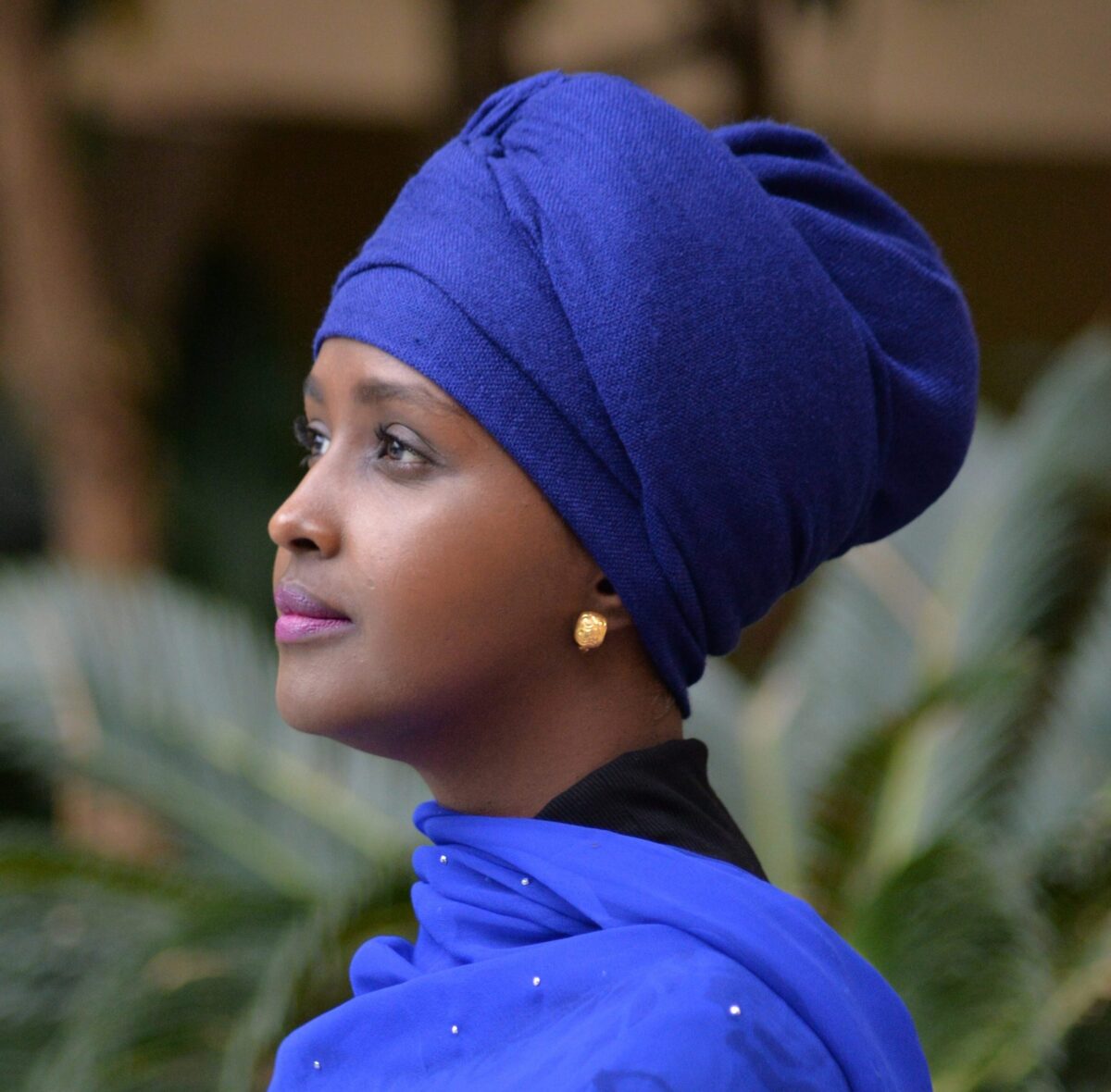
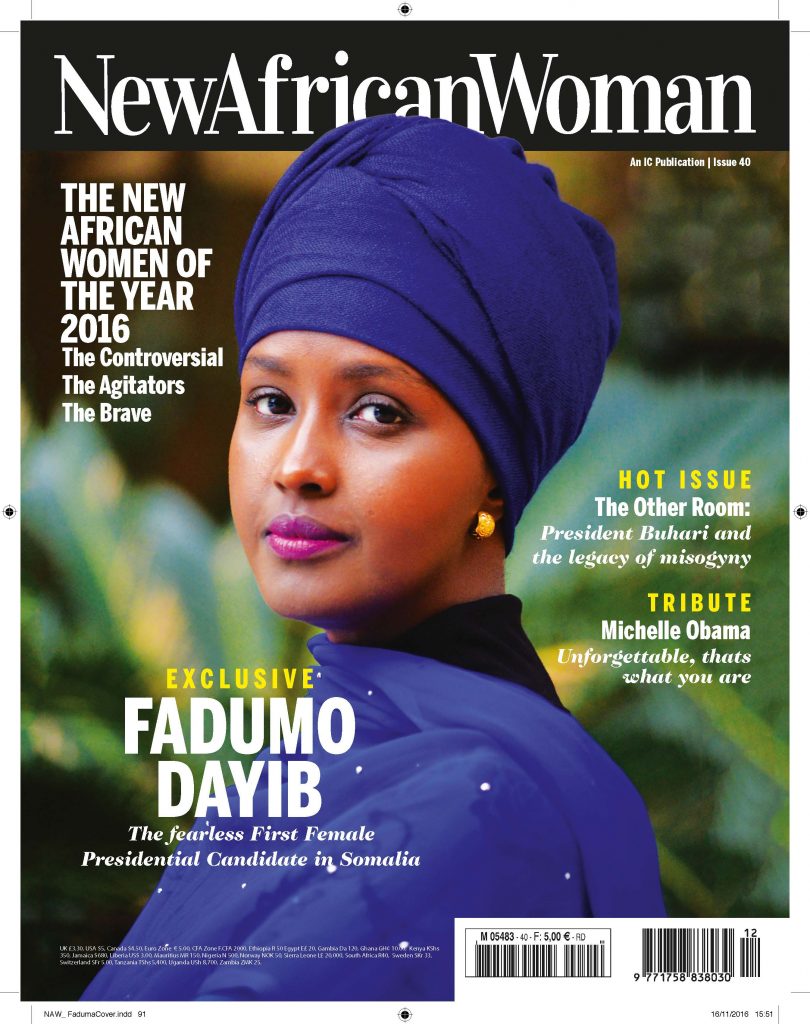
Fadumo Dayib’s brave declaration to stand as the first ever female Presidential candidate in Somalia’s Presidential Elections back in 2016 gripped Africa and its Diaspora. Not since that of Africa’s first female president, Ellen Johnson in Liberia – has news of a woman politician seeking high office been so exciting. And in Fadumo’s case even raised worry. She eventually withdrew from the race citing corruption, fraud and intimidation. Our Editor reGina Jane Jere caught up with her.
New African Woman: Your have been one of the most exciting names of 2016, your name is literally everywhere for the fact that that you are the first woman to dare stand as a Presidential candidate in Somalia and vehemently challenge the status quo. Just give us a bit of a backgrounder, who is Fadumo?
Fadumo :Oh my God! I wish I knew why they are getting excited about Fadumo. In a nutshell I was born into displacement to two illegal Somali immigrants in Kenya. My father was a truck driver who spoke several different languages fluently, although he was illiterate and he couldn’t read and write. My mother was a nomad who had a head for numbers and she was a brilliant mathematician. She could just calculate figures off the top of her head while others struggled with the calculator. Despite the fact that she was also not formally educated. She only started reading and writing at a very late stage of her life, just before she died in Finland. These are the two wonderful human beings who brought me into this world.
My mother had been married off at a young age as a child bride and she had lost 11 children as a young mother to treatable diseases. Eventually she was told: “Go to Kenya maybe you might have children who stay alive.” And so she did and she set off with her brother. They were given a lift in a truck by a man who fell in love with her. Although they were both in the country illegally, he proposed and got married and they soon gave birth to me had me in a place called Thika. I was also a sickly child, and having lost 11 children already my mother was always worried, but I managed to survive. My second name is Deeqo, which means “sufficient”. My mother said if this child stays alive and she’s the only child I will have, she is sufficient. Thankfully she came to have two more. I have a young brother and sister.
How was life growing up as a an illegal immigrant in Kenya?
Well, when I was just beginning to perfect my reading and writing at the age of 14, the Kenyan administration deported us in 1989, along with many other first, second and third generation Kenyan –Somalis.
Given your background and at such a tender age, did this lifestyle make you who you are today? And given the history of Somalia, you are taking on quiet a daring challenge. Why?
Because I believe that saving Somalia is a civic duty, it’s a moral obligation that is incumbent on all Somalis. It is immoral of any one of us to watch people dying and not do anything about it because silence means you are part of the problem, you are an accomplice to the crimes that are being committed in this country.
I am therefore running for the Presidency because I actually believe that I can make a difference.
The reason why I gave you all that my background is for everyone out there, to get an understanding of where I come from. I was born into poverty, into disadvantage, into violence and depravation. You cannot imagine the kind of violent life I was exposed to as a child. But I am able to do what I am doing because of the opportunities that were given to me later in life such education, good healthcare, security, and stability,
I believe if every African child is given those same opportunities they can do wonders, even more than what I am doing. This is my passion and what I want to give to the young Somalians.
But Fadumo Somalia is a country that has gone through a lot and lasting security and stability you mention, remains largely elusive. As a woman in a country which is very well-known for its patriarchy and the denigration of women, you are going in with your hands tied at the back, how do you react to that?
I don’t react negatively and I don’t take offence because such views I believe reflect the current world order, not just Somalia as to how women are treated. Just look at what has happened in America and to Hilary Clinton, where 40% of the white women, educated, emancipated white women decided to vote for a man who believes women should be grabbed by their pussies. This is really not just an African issue, it is a global problem.
As women, particularly women who are empowered, who want to make a difference in the world, we are facing a huge problem and its more evident now – if anyone is in doubt, just look at what has happened in America.
Do you think this will discourage women from becoming as daring as you and challenge the status quo because the message out there now is “women stand little or no chance”?
No, I don’t look at it that way, what I see is that we in the women’s movement are focusing on the wrong group. We always tend to focus on seeing men as our enemies. We need instead to convince them, empower them, and them understand why they should be on a woman’s side. Often it is not the men who let us down it is fellow women. It is that woman who has internalised misogyny or sexism and who believes her place is supposed to be at home and like Nigerian President said recently in the “other room”, and if you don’t stay there then they see you as really breaking the rules and norm.
Fellow women are often the most difficult to convince and they are the ones who will attack you the most. They are the ones who will tell you that you will not succeed, and will not support you morally or financially or in any other way. Surprisingly, the biggest supporters and those pushing me in this campaign for my candidacy are actually men and the highly educated women who understand the importance of what I stand for. But the biggest target, the one that really need convincing are the grassroots women. Women who feel that it is not a woman’s place to be in leadership, but should be at home.
How are you going around that because it’s quite a predicament, isn’t it? Because I am sure in most parts of the world, I think, the voting system is very female-led so you need female votes.
Yes, this is unfortunately the way that the situation is in Somalia. If we had a one person/one vote elections system, many women including those way out in the rural areas, who can read and understands what my manifesto and what I represent, will walk, to the nearest polling station and vote.
And is that because of the long held subjugation that Somali women go through? And you talked about the financial support or lack of it, and I think women in Somalia or most parts of Africa, or any other part of the world, not being financial independent holds them back, don’t you agree?
On the contrary, Somali women are actually really empowered, they are the ones who fundraise for male presidential candidates. If a hospital needs to be built it will be built by women because they know how to fundraise. If a school has to be set up or school books or something has to be paid for, it is women who will come together and fundraise.
Somalia women played a crucial role to broker the little peace we have today. They fundraised for it. Therefore, Somali women are not powerless, on the contrary. But when comes to coalescing around women’s issues if it is or supporting women to get into positions of power, the attitude is different.
How are you going around that because it’s quite a predicament, isn’t it? In most parts of the world, the female vote counts and is always bigger. You will need the female vote.
Yes, this is unfortunately the way that the situation is. But, if given a chance to read and understand what my manifesto is, or once they have understood what I really represent, and we have one person/one vote elections in Somalia, many mothers out there in the rural villages will walk to the nearest voting station and vote for me.
But you know one thing that we need to do as women on the question of funding? To bypass that, we have to find ways that we can fundraise so that women, politicians, wherever they are in the world, can benefit from this funding. We don’t have that now. The Somalian male presidential candidates, have their business acquaintances, they have their religious affiliations and so they get funding from all these sources and of course, from the women in their plans.
A female candidate doesn’t have any of that and the fact that she even has the guts and the stubbornness to even contest for such a position leads her to be isolated from her community, from her society and at times, even some of them end up losing people who are very close them.
But the biggest target, the one that really need convincing are the grassroots women. Women who feel that it is not a woman’s place to be in leadership, but should be at home.
So how are you working your campaign?
I have moved to, and set up a base in Somalia. I have been here for the past one month now. I have resigned from my job, I have left my family in Finland.
Are you all right and do you feel safe?
I am here not just without proper funding, but without even proper security.
Lack of security should surely be of a big concern to you as a mum and it’s a huge sacrifice, Somalia’s problems with security and assassinations is well documented, why , many will ask, are you risking life for this? Is that the case?
Yes I have received death threats and even now that I am in Mogadishu, I am constantly very much aware of the fact, that every time I leave my house, that could be the last time I am leaving that compound and that I might not return there.
That’s very scary. Is it worth it?
Yeah, it’s a very constant awareness, even when you are sleeping at night, that I might not make it until tomorrow morning. Anyone can throw a bomb here, anyone can come in with a suicide vest but you know what? I believe twelve million Somalis are worth that, they are worth that. Somalia is worth that, it is worth my life, I love my country and I love my people.
And surely you also love your children?
I love my children but I am doing this precisely for them. I have been away from the country for twenty six years, I have led an existence of a beggar in countries that are not mine. Always, always, always, always, always wanting to go back. My generation is on its way to… Some of us don’t even make it to the age of fifty. So, we want to leave a good legacy for our children.
This, as a mother, is really my responsibility to make sure that our children have a place to come back to a country that can accept them, take them back and that can give them a dignified existence. So, I am not doing this just for myself, but I also do it for my children and for the countless other millions of Somali children inside the country.
For those 1.7 million Somali children who are out of school, for the 67% of the youth who are unemployed and who are getting on boats, trying to get to European countries also America or other countries, I am doing it for them. I’m doing it for that young Somali girl who is married off at the age of twelve and is developing health complications, has a fistula and has to be stigmatised for the rest of her life.
I am doing it for the Somali mother that dies during labour, childbirth. I’m doing it for that Somali child who would die before reaching his first year or even some of them don’t make it to their fifth year. Some of them are still dying due to the diseases that my eleven siblings died of, things that are preventable.
So, is my life more important than that of twelve million Somalis? I don’t believe so.
If you actually had to have a dialogue with the other side, like those in power now, would you say to them “Look guys, it can be a unifying thing if we all worked together”, would they listen to a person like you?
You know the problem Somalia has is that people are so vested in conflicting interests. The people in power, although they claim to be Somalis, they are actually not in power because the majority of the Somalis put them there, they are there because 1%, a highly elitist exclusionary group, a privileged group, has put them there. They are only catering to the interests of that 1% and to their own interests. So they would not be interested in having any dialogue. That child dying on the streets isn’t theirs, that woman who is dying during labour isn’t their wife, she isn’t their mother, she isn’t their daughter. They couldn’t care less.
If one of their people gets sick they will fly them off to Turkey or somewhere else. Their kids are going to international schools abroad. They live in a very much cocooned, protected life and so why should they care, and they do not hear about the dialogue, they don’t want to hear people like us speaking about dialogue.
So that surely makes it even much harder for you to unseat people who are so comfortable in that lifestyle and they don’t care. That must really make it even harder for you.
On the contrary because 80% of the Somali population has expressed the fact that they want democratic elections, they want one person one vote. So in 2016 this government was supposed to have paved the way for democratic elections, which they didn’t do because they still want to hold onto their interests, they know that the moment we have democratic elections they will be kicked out.
Are they still resisting the 2016 date?
They did, they dragged their feet and now we are back to this 4.5 clan-based system, which means the 1% elite gets to now again select the same people into power. What I’m telling you is actually what a Somali person on the street will tell you. The same sentiments, because this is what they have been saying all along, we don’t want clan elders selecting people we want to be able to exercise our democratic rights which have been taken away from us for the past 48 years, we want to cast a vote and whoever comes into office is someone that we brought there. We can hold them accountable, you know, bang on the table and say, “What have you done with all the money that was given to you?” But how can you do this with this administration? You didn’t get them there. So you see, I think a lot people do not not understand the challenge in Somalia … the fact that 99% of the Somali population is being held hostage by just 1% of elite group.
If you became the next President of Somalia what would you actually prioritise? what is the most pressing issue that is holding such a great country back?
Security is the main thing that I would focus on, because really without security you cannot have peace and you cannot have economic prosperity.
And how would you do that?
By negotiating, having a dialogue with Al-Shabaab, that would be my first priority because it is important that we are able to have a dialogue with even people, the most repulsive segment of the society we must learn to be able to even dialogue with them and not resort to violence because violence, every time.
If violence were to bring any solution Somalia would be the most peaceful country in the world today, considering the amount of violence that has gone on. And so dialogue is very important, but there are three conditions which Al-Shabaab must meet: it must disarm, it must stop killing Somalians and it must renounce its affiliation with international terrorism.
A lot people do not not understand the challenge in Somalia … the fact that 99% of the Somali population is being held hostage by just 1% of elite group.
And do your children understand what their mum is doing and risking?
They understand and they also understand that they are servants and if anything should happen to their mother, they will have to pick up the fight, they will continue to fight, unless change can come.
They understand that and most of all they understand why it is important that they should fight for democracy. Why they should fight for people who are in a bad situation compared to them. I am very blessed to have children who support me, who whenever I am leaving them behind for this campaign and , I sit them down and I tell them, “Your mum is leaving and maybe this is the last she will see you, but you must know that your mother loves you as much as she loves the twelve million Somalis that are out there and if anything should happen to me, you pick up from where I’ve left off.” They hug me and they tell me, “Mum, you are the best mum, we are blessed to have you.”
On The Cover Dec/Jan issue Out now – Click to Subscribe!

What's Your Reaction?